
Additional Information
Rain capes made of various materials have a long history in China, and the earliest known examples were made of straw. After the Ming dynasty, more elaborate examples were woven with grass the colour of jade, which was soft and waterproof. During the Qing dynasty, rain capes were woven using pipal tree leaves.
In rural Japan, people use materials that surround them – rice and wheat straw, reed, bark, vines, and seaweed – to create capes, mino, hats, yuki-boshi, and boots, yuki-gutsu, to wear in rain and snow, and back protectors, bandori, for carrying heavy bundles in the mountains. Indigenous people living on the Pacific Northwest Coast made rain capes and hats from shredded and oiled cedar bark, stripped from the magnificent red and yellow cedar trees. Today, in many areas, clothing made from local renewable resources has faded from use and been replaced with plastic rainwear.
The exquisitely crafted garments displayed here have been transformed from resources of the earth into objects of great beauty and usefulness. They are cultural expressions of a universal respect and enjoyment of natural materials, and they draw attention to the diversity of ways objects are created to be functional and fulfill a need, but contain a beauty born of use.
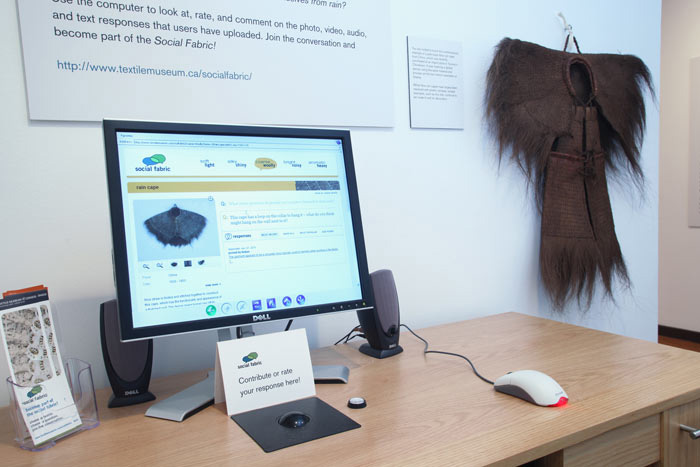
In the gallery you will see a Chinese palm bark rain cape that was made in the mid to late 20th century. This cape also appears in the Coarse Wooly section of Social Fabric, the Textile Museum of Canada’s brand new interactive Web site. Discover it for yourself, in real and in virtual space.
Social Fabric is a forum for everyone to respond to this and 49 other textiles from our collection. From your computer or in-person in the gallery, you can rate and comment on responses or dream up some of your own.