Second Life: Strawberry Emery (Pincushion)
Update: This workshop has sold out. Please contact Isabelle Sain (isain@textilemuseum.ca) to be added to the waitlist.
September 9-11, 2026 (Three-part Workshop)
1-4 PM
FREE
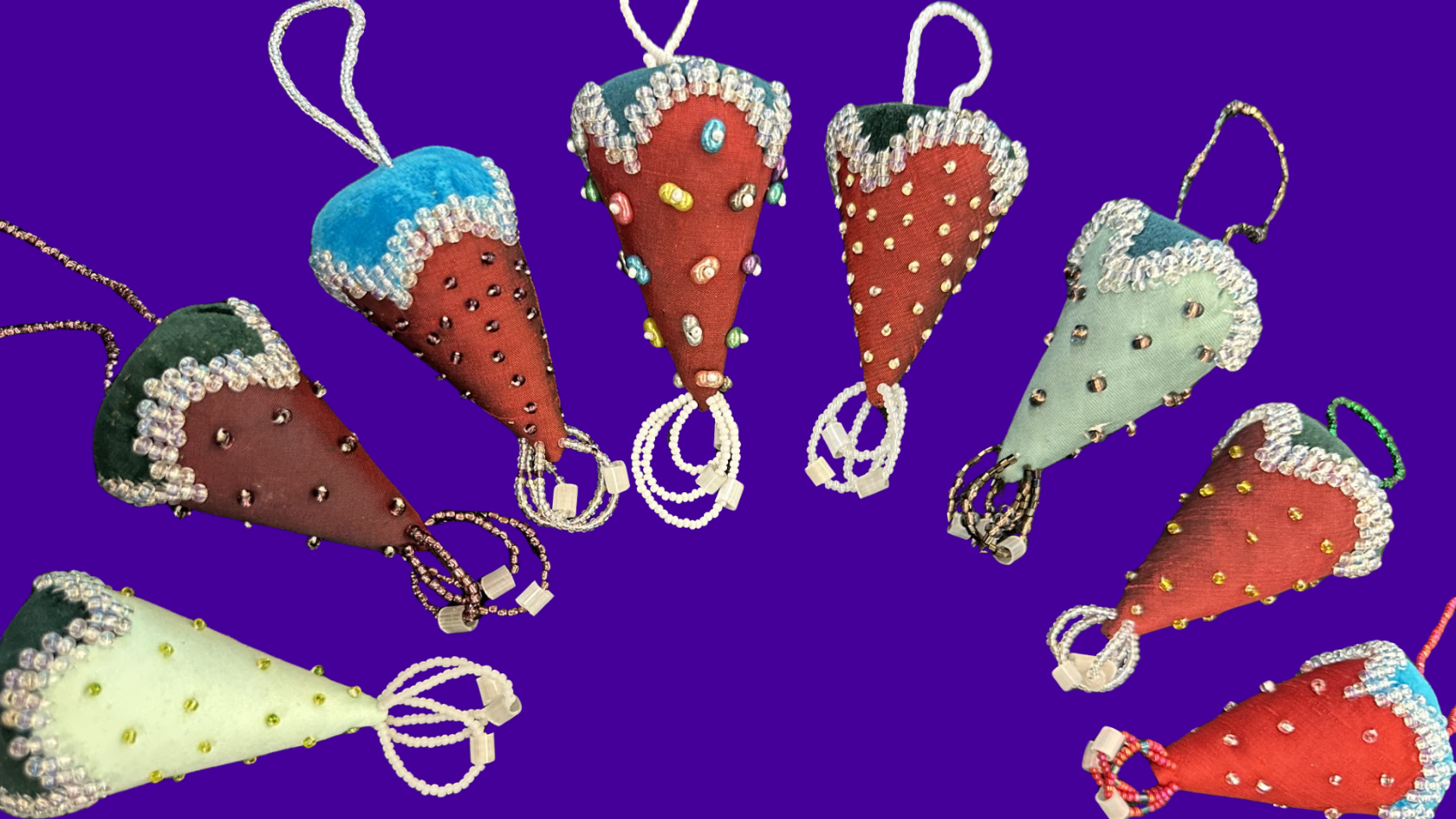
Strawberries is a Native Medicine plant. They are considered the first fruit that nourished us after a long winter, and we honour the Strawberry for this reason. The Annishnabeg term for Strawberry – “Ode’ imin” means heart berry which describes how the Strawberry looks like a heart.
This important sacred fruit took the form of the popular sewing emery in the 1800s. Emeries were composed of all manners of fabrics. They were stuffed with sawdust and usually emery sand.
Originally the Strawberry emery (pincushion) was fashioned for utilitarian use. They served a vital function of keeping pins and needles safely stored in the Victorian ladies’ sewing box. At this time sewing needles and pins were imported from Europe, and these small delicate implements were in limited supply. Sewing tools were viewed as precious commodities in every household.
Early Indigenous examples of the beaded Strawberry emery were expertly composed of pretty, costly left-over dress fabrics, which contributed to the charm of this functional art form.
Indigenous-made Strawberries are unique not only in style and beadwork techniques, but are composed of an infinite variety of materials, making each one an individual artistic creation. Indigenous bead artists continue with this tradition.
This workshop will provide participants with the opportunity to create and sew their own Strawberry using reclaim materials using Indigenous beading techniques.
This is an all-skill levels workshop, however experience with hand sewing is an asset. Indigenous teachings will be part of the learning experience.
Registration is free and prioritizes access-seeking, disabled, and underserved communities who are looking to build community and grow within the arts. The Textile Museum is committed to making this workshop accessible and barrier-free as possible. If you have already attended a Second Life Workshop, please consider opening space for new community members to access these free workshops.
About Second Life: Sustainable Textile Workshops
‘Second Life: Sustainable Textile Workshops’ is a series of free; sustainability focused workshops developed with the Textile Museum of Canada and contemporary local artists. The series converges ecological thinking with art-making opportunities for our community. Starting in January, each month, the Museum will bring in an artist who confronts the climate crisis by rethinking materials and reimagining textile processes, decolonial methodologies, and sustainable craft traditions. Together, artist and participants will reform reused materials to create new works of art through a variety of techniques. These textile-focused artistic mediums will include weaving, embroidery, crocheting, quilting, natural dyeing, felting, upcycled fashion, or mixed-media fiber practices.
Facilitator Bio:
Naomi is an Indigenous Artist, Maker and Educator from the Chippewas of Nawash Nation in Neyaashiinimiing. She focuses on teachings about the Indigenous people of Great Lakes region from a historical and contemporary perspective often through the story of beads. Her work embraces ancestral designs in the form of bags, adornment and traditional accessories. Naomi’s work has been exhibited across Canada and internationally. She has exhibited at the National Museum of the American Indian (NMAI) (Smithsonian) in Washington DC and New York, the Vancouver 2010 Olympics, Peel Art Gallery Museum and Archives, and Art Gallery of Guelph. Naomi has also participated in several EAC Seminars over the last two decades.
Naomi’s artwork is in permanent collections at the Museum of Fine Art in Boston, MA, The Art Gallery of Guelph, Schneider Haus, The National Gallery of Canada and private collections throughout the world.
“Honouring our traditions is my voice within and beyond my Culture and Community. Traditionally there is no word for “art” in Native languages, yet artistry and visual expression are critical in defining who we are as Original people. It is this path I wish to exemplify through my teachings and my work.”
-Naomi
Become a Member of the Textile Museum Today
And enjoy unlimited free entry to all the Textile Museum's exhibitions, plus much more.
Join Today